Showing posts with label Initiate. Show all posts

Tuesday, September 26, 2017

The Frog in Hot Water

You identify a niche, you build a product.

You talk to a few early customers, they try it out.

As a startup you have a zillion things to do. Out of the many axes of optimisation, you optimise the few that you want to strategically focus on.

Your customers love it, it solves a big problem for them. They are excited about it.

The good word about your product spreads and you attract more customers. Soon you have a healthy growth rate.

And then it happens. What your customers thought were minor inconveniences have snowballed into a major issue stream with your product.

Everything was going well, so what exactly happened?

As your product evolves, your customer set evolves too. The early adopters were more adaptable, because it fixed a pain point for them. As your product becomes mainstream, the customers that you attract, and their expectations are mainstream. They expect things on the axes that you didn’t intentionally optimise for.

What you choose to do when faced with this solution is up to you and your product’s domain. But it helps to be cognisant of the fact that this may happen, and look out for it before it is too late to leap out of the pot.
Wednesday, March 22, 2017

What is “success” to you?


Different people, different definition.

Same person, different circumstances, different definitions.

What is success to you right now?

Work for a big label company? Create something that is highly valued/appreciated? Make a lot of money? Feel happy about what you are doing? Buy that BMW that stole your heart? Be indispensable at what you do? Be socially appreciated? Being happy?

AND, are you achieving success regularly? If you haven’t yet, is what you are doing today bringing it any closer?

It helps to revisit every once in a while.

If you do, you know what you have to do today, to reach your definition of success.

If you don’t, you keep envying others for what you don’t even want (the social perception of success).

Tuesday, January 17, 2017

On Startup Books

(Originally published at: https://medium.com/@kedars/on-startup-books-56c1b9ac8e7#.sp4sjixpj  . Copying errors may exist.)

While many are worth mentioning here, the following 4, I believe, are some of the must reads:

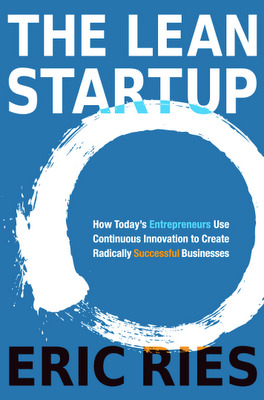
The Lean Startup

The way Eric Ries highlights the pain he felt on spending time and energy working on things that their team thought was valuable to their customers, and the solutions he proposes to shorten that path are very easy to relate to. The concept of avoiding wastage by being very close to your customer (starting with a paying customer) rather than being boxed by sitting on your desk is well put forth.

He also makes a case for not only applying the principle initially, before your get to product-market fit, but throughout your engineering cycle as your product matures. It is the development of an experimental attitude rather than a list of bullet points.

    “If you are not embarrassed by the first version of your product, you’ve launched too late.” — Reid Hoffman

Release early, get feedback, improve and iterate.

Word of caution: Make sure you balance the vision v/s customer-feedback.

    “If I had asked people what they wanted, they would have said faster horses.” — Henry Ford (or maybe not)

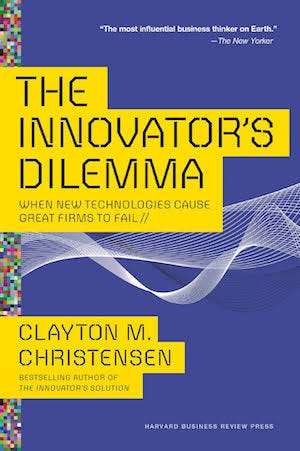
The Innovator’s Dilemma


While The Lean Startup talks about avoiding wastage by listening to your customers, this books lists how listening to your customers makes companies miss out on the technological shifts that disrupt the landscape. It is a great book that highlights the advantages of being small and new over big and established. And captures quite a few studies about how established incumbents were displaced with these technological shifts. It is a great book for all startup founders as well as employees looking for new ideas with tiny markets.

My few key takeaways:
  •     Disruptive technologies are often characterized by poorer performance for the mainstream attributes. But they are attractive to a tiny set of customers. Thus they open new markets with different value proposition.
  •     Large companies don’t want small markets. And their mainstream customers aren’t interested in the new value proposition. So they don’t invest in disruptive technologies.
  •     With high pace of technological progress, disruptive technologies soon surpass established (sustaining) technologies and are appealing even to mainstream customers.
  •     Mainstream customers, now, as if all of a sudden, wish to move to the newer disruptive technology that the large company has been ignoring.

And finally, even if the large company invested in disruptive technology, it might do so with a sustaining technology mindset, thus setting up for failure from the get go.

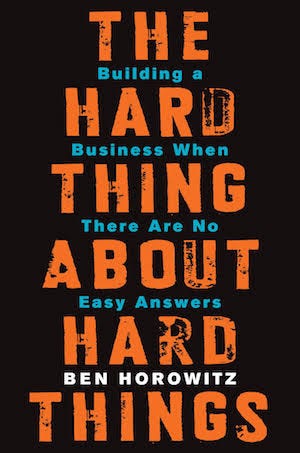
The Hard Thing about Hard Things


Ben Horowitz writes about their journey through Opsware in this book. This is a must read by any founder or startup employees.

They came quite close to the brink a few times as they were going through this experience. It emphasizes how any startup requires improvisation. Particularly, even when they had Ben and Marc (with Netscape success already behind them) as a core part of the process.

For employees who come from non-startup backgrounds, they find the uncertainty, the experimentation, the improvisation too unnerving. And a pivot is really the end of the world for them. These guys don’t know what they are doing they end up thinking. And that helps nobody. All potential startup employees must read this book. Startups aren’t just about getting from 0 to 100, but it is about venturing into the uncharted, defuzzing the uncertainty is the adventure.

Great Management Reference: This also happens to be a great reference book for all things people management. Right from dealing with your best employee who starts feeling entitled, to team culture and accountability and creativity. Always a great book to have close at hand and refer to, in time of crisis or otherwise.

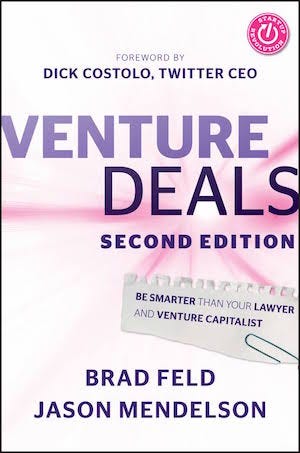
Venture Deals


This is my final recommendation for all startup founders, particularly first-time founders.

It captures details about founder agreements, equity funding process, raising money, term-sheets, fine prints. It even includes samples/templates for the most standard terms that are present in most of these VC documents.

It is a great read for anyone trying to understand how the internals for startup financing work.

Thursday, December 08, 2016

A seed of an idea

A seed of an idea. Like many others that you thought of. But this seems different. Something interesting. Something more.

You keep thinking about it. Look at it from all the angles. It looks promising.

You discuss it. Yes, you had already thought of that angle. And you thought of it the other way too. But wait wait, you didn’t look at it in this fashion. Oh and also, how about that possibility? That is probably a better a way of approaching it. Interesting, very interesting…

Did somebody already try that? Was that a success or failure? They probably didn’t execute it right. There are many ways it could go wrong, but you, you can do right.

You build a tiny prototype. Just that core piece that is oh-so-critical. Looking good. Now that you see it work… its amazing. Didn’t think this would be an added advantage. Or is that the primary benefit? Hmm…

You know that you know a lot more about it now, than when you started. You know there is so much more.

You have a good hold of that idea now. Or probably the idea has a hold on you.

It is evolving in your sleep. It gives you sparks of brilliance at 5 in the morning. You shudder out of sleep in ecstasy. You know, you rock!

It occupies you all the time.

Breakfast, lunch, coffee or dinner.

You live the idea.

You breathe it.

The idea goes with you everywhere.
 
The idea takes you places.

Give it thought. Give it time. Give it action. Do it!

Thursday, January 15, 2015

This is *your* project

That is clearly the most repeated message when we guide projects for the Dreamz Group.

In our minds, ever so slightly, we stop being in the driver's seat. But the reality is, its just us, it is our project. Others will help us, they guide us, but its us who decides where the car is going.

And it happens at work too... You are knee deep in it, you have to drive it. Everyone else has only a limited perspective, however experienced they are. Take the right calls, raise the right issues.