Showing posts with label Lead. Show all posts

Tuesday, September 26, 2017

The Frog in Hot Water

You identify a niche, you build a product.

You talk to a few early customers, they try it out.

As a startup you have a zillion things to do. Out of the many axes of optimisation, you optimise the few that you want to strategically focus on.

Your customers love it, it solves a big problem for them. They are excited about it.

The good word about your product spreads and you attract more customers. Soon you have a healthy growth rate.

And then it happens. What your customers thought were minor inconveniences have snowballed into a major issue stream with your product.

Everything was going well, so what exactly happened?

As your product evolves, your customer set evolves too. The early adopters were more adaptable, because it fixed a pain point for them. As your product becomes mainstream, the customers that you attract, and their expectations are mainstream. They expect things on the axes that you didn’t intentionally optimise for.

What you choose to do when faced with this solution is up to you and your product’s domain. But it helps to be cognisant of the fact that this may happen, and look out for it before it is too late to leap out of the pot.
How often are you in the ‘flow’?

You are coding away. A minute goes by… You check the watch, and its been two hours!

You don’t know how those two hours went by, but they were very productive. You feel good. Happy. A joy that comes of active creation.

You, my friend, were in the flow. It’s a state that is a reward in itself, a state with your highest of performance.

Given that, can we try to create conditions to get into that state as frequently as possible? What works for you? How often do you find yourself in the flow?

I find myself at my productive best when I can get at least two sessions of complete concentration in a day. These sessions don’t include checking email, or Facebook, or having design discussions or reviewing other’s work. They include working by myself, typically on a programming assignment. And often it happens when the stuff is churning in my mind for quite some time. So once I sit down, all those thoughts just spill over through the keyboard onto emacs.

Wednesday, March 22, 2017

What is “success” to you?


Different people, different definition.

Same person, different circumstances, different definitions.

What is success to you right now?

Work for a big label company? Create something that is highly valued/appreciated? Make a lot of money? Feel happy about what you are doing? Buy that BMW that stole your heart? Be indispensable at what you do? Be socially appreciated? Being happy?

AND, are you achieving success regularly? If you haven’t yet, is what you are doing today bringing it any closer?

It helps to revisit every once in a while.

If you do, you know what you have to do today, to reach your definition of success.

If you don’t, you keep envying others for what you don’t even want (the social perception of success).

Tuesday, January 17, 2017

On Startup Books

(Originally published at: https://medium.com/@kedars/on-startup-books-56c1b9ac8e7#.sp4sjixpj  . Copying errors may exist.)

While many are worth mentioning here, the following 4, I believe, are some of the must reads:

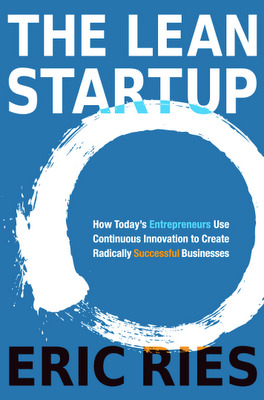
The Lean Startup

The way Eric Ries highlights the pain he felt on spending time and energy working on things that their team thought was valuable to their customers, and the solutions he proposes to shorten that path are very easy to relate to. The concept of avoiding wastage by being very close to your customer (starting with a paying customer) rather than being boxed by sitting on your desk is well put forth.

He also makes a case for not only applying the principle initially, before your get to product-market fit, but throughout your engineering cycle as your product matures. It is the development of an experimental attitude rather than a list of bullet points.

    “If you are not embarrassed by the first version of your product, you’ve launched too late.” — Reid Hoffman

Release early, get feedback, improve and iterate.

Word of caution: Make sure you balance the vision v/s customer-feedback.

    “If I had asked people what they wanted, they would have said faster horses.” — Henry Ford (or maybe not)

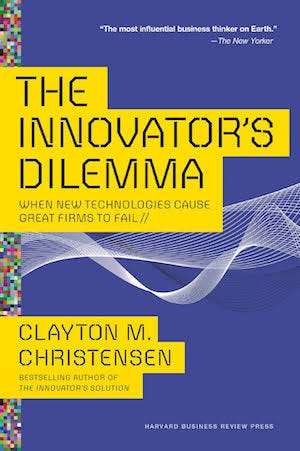
The Innovator’s Dilemma


While The Lean Startup talks about avoiding wastage by listening to your customers, this books lists how listening to your customers makes companies miss out on the technological shifts that disrupt the landscape. It is a great book that highlights the advantages of being small and new over big and established. And captures quite a few studies about how established incumbents were displaced with these technological shifts. It is a great book for all startup founders as well as employees looking for new ideas with tiny markets.

My few key takeaways:
  •     Disruptive technologies are often characterized by poorer performance for the mainstream attributes. But they are attractive to a tiny set of customers. Thus they open new markets with different value proposition.
  •     Large companies don’t want small markets. And their mainstream customers aren’t interested in the new value proposition. So they don’t invest in disruptive technologies.
  •     With high pace of technological progress, disruptive technologies soon surpass established (sustaining) technologies and are appealing even to mainstream customers.
  •     Mainstream customers, now, as if all of a sudden, wish to move to the newer disruptive technology that the large company has been ignoring.

And finally, even if the large company invested in disruptive technology, it might do so with a sustaining technology mindset, thus setting up for failure from the get go.

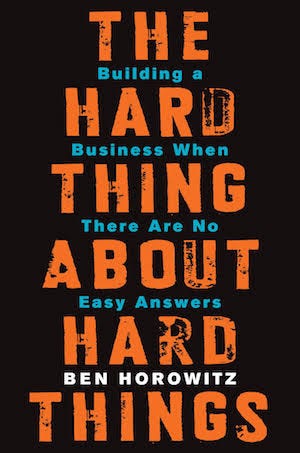
The Hard Thing about Hard Things


Ben Horowitz writes about their journey through Opsware in this book. This is a must read by any founder or startup employees.

They came quite close to the brink a few times as they were going through this experience. It emphasizes how any startup requires improvisation. Particularly, even when they had Ben and Marc (with Netscape success already behind them) as a core part of the process.

For employees who come from non-startup backgrounds, they find the uncertainty, the experimentation, the improvisation too unnerving. And a pivot is really the end of the world for them. These guys don’t know what they are doing they end up thinking. And that helps nobody. All potential startup employees must read this book. Startups aren’t just about getting from 0 to 100, but it is about venturing into the uncharted, defuzzing the uncertainty is the adventure.

Great Management Reference: This also happens to be a great reference book for all things people management. Right from dealing with your best employee who starts feeling entitled, to team culture and accountability and creativity. Always a great book to have close at hand and refer to, in time of crisis or otherwise.

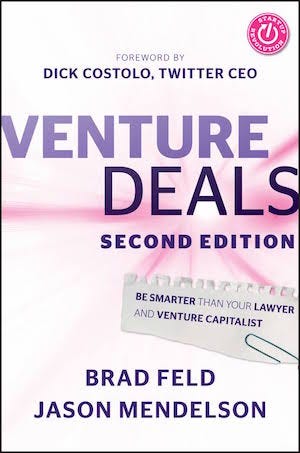
Venture Deals


This is my final recommendation for all startup founders, particularly first-time founders.

It captures details about founder agreements, equity funding process, raising money, term-sheets, fine prints. It even includes samples/templates for the most standard terms that are present in most of these VC documents.

It is a great read for anyone trying to understand how the internals for startup financing work.

Thursday, December 08, 2016

A seed of an idea

A seed of an idea. Like many others that you thought of. But this seems different. Something interesting. Something more.

You keep thinking about it. Look at it from all the angles. It looks promising.

You discuss it. Yes, you had already thought of that angle. And you thought of it the other way too. But wait wait, you didn’t look at it in this fashion. Oh and also, how about that possibility? That is probably a better a way of approaching it. Interesting, very interesting…

Did somebody already try that? Was that a success or failure? They probably didn’t execute it right. There are many ways it could go wrong, but you, you can do right.

You build a tiny prototype. Just that core piece that is oh-so-critical. Looking good. Now that you see it work… its amazing. Didn’t think this would be an added advantage. Or is that the primary benefit? Hmm…

You know that you know a lot more about it now, than when you started. You know there is so much more.

You have a good hold of that idea now. Or probably the idea has a hold on you.

It is evolving in your sleep. It gives you sparks of brilliance at 5 in the morning. You shudder out of sleep in ecstasy. You know, you rock!

It occupies you all the time.

Breakfast, lunch, coffee or dinner.

You live the idea.

You breathe it.

The idea goes with you everywhere.
 
The idea takes you places.

Give it thought. Give it time. Give it action. Do it!

Sunday, May 01, 2016

The Dreamz Experience


Recently I attended the project exhibition at my Alma-mater. I was excited to sit through the presentation of a project group. The oh-so-familiar logo splashed on their opening slide:

Like the flashbacks in Bollywood movies, it all flashed in front of my eyes. Thirteen years! Its been thirteen years since the Dreamz Group has been guiding these capstone/final year engineering projects. Doing something consistently and with high quality for that long is certainly something.
It all began in 2003, when a group of us friends thought we should do something to build better engineers coming out of colleges. The decision was to focus on these final year projects, be good mentors to the students. And then identify challenging problems to solve, work on their solutions, and do so by following best practices from the industry.
The initiative was very successful. Our projects won prizes at prestigious institutes, presented papers at conferences like OLS, but importantly I believe it was an awesome learning experience for everyone involved, the mentor and the mentee.
We never intended for it to run this long, so we certainly must have done something right, probably accidentally, along the way. And I have been thinking what made it work, here are the top few. Most of these seem basic common sense, but hey, that’s what made it.

The “Why”?

We did a good job of internalizing why exactly are we doing this. It provided us a great anchor to base our decisions and take on new initiatives. Every year, any session we did with students, we reiterated publicly why we are doing this. We threw the doors open for anybody looking for help to reach out to us. I think these repeated public declarations, helped everyone internalize it. Probably like a pledge but with more earnestness and meaning.
A case in point is how we viewed other project guiding groups that came up over the years. We always aimed to get along well with all these. In fact, for students that had gone through our screening process, we also shared our true feedback about them and made referrals at other places for guiding projects. There is no rivalry in teaching, its a good deed.

Involvement

After a couple of years of the activity, we thought: why should learning (or involvement) stop when the students finish off their projects? What else could you do? Since then the senior students were deeply involved with our screening process, running many rounds all by themselves. Some interested folks also acted as co-mentors for the next batches of students. Regular sync-ups ensured that the same values and ethos carries forward through the process.
In all of this, I think everyone developed a sense of ownership, and a community around this work. We made many changes in our processes and approaches, and almost every one of them came through by suggestions from the newly involved folks. We automatically kept up with the times, because a younger batch kept guiding us :).
Along the way, the baton of organizing and mentoring these projects has gone from multiple generations of students. My hearty thanks to all those who have been involved.

Mutual Respect

I learned many things through this activity, but the biggest take away, no doubt, was people.
While I was at this project exhibition (that I mention at the top), I met many folks who I had the privilege of mentoring. Folks, across multiple batches, few of the best students in the best educational institute, and who have gone on and made a difference.
I don’t meet most for years, but when we do meet, the mutual affection and respect gushes forth like a reborn stream at the sight of first rains. It is these bonds, these relationships that make it so worthwhile.

Times change, technologies change, and this initiative will continue to adapt and finally stop at some point. Till then, here’s to hoping more such fun experiences!

Thanks to pixabay for the title image.

Saturday, February 14, 2015

Be the customer

I have learned this time and time again. 

Yes, you have brain stormed on the new features for a long time, and yes it is an elaborately well thought-out plan. But please,

Be your own customer.

Start by writing the User Manual for the feature that you envision before the development begins. If you are going to release the feature over multiple iterations, write the manual for all the customer-visible iterations. This helps you shed the developer mindset, and forces you to really be in the customer's shoes every step after step. Obviously some activities are exploratory in nature, and don't quite fit in this format. But most of them usually do.

Secondly, start using the generated product as early as you can. And use it like a customer would to solve her problem. This not only influences your scheduling, to have workable versions earlier in the development cycle, but also helps you identify / fix the minor annoyances, that make your product truly stand out. Depending on the nature of your product, you may have to go to great lengths to really enable this.


Easier said than done... :)

Sunday, February 01, 2015

The Release Rush

I am an avid fan of Masterchef Australia!

I love watching the excellent participants, working on their culinary recipes, race with each other towards the deadline.

I wondered why they all feel so rushed up towards the finishing line often finishing only seconds, before the deadline.

It happens no matter how long the time slot is, or how simple the cuisine is. And it happens to every participant, even the most expert cooks, with a spectacular plan and meticulous execution. Why so? Bad planning?

And then I wonder, how I would feel if a participant finishes 10 minutes before their deadline. They finished alright, but could they have delivered more? Did they take it too easy? Not just for the sake of competition, but for realizing their own potential.

The goal is not just to deliver, in the given time. That is not success.
The goal is to deliver your best, in the given time. That has the potential to be a success.


Saturday, January 17, 2015

Fresh Minds == Fresh Ideas

Seems quite obvious but very hard to follow...

Once we are working on something for an extended duration of time, the base assumptions get latched on to our mind. We continue to be actively focused and working towards our targeted milestones, ignoring these along the way. It takes a fresh mind to question these assumptions. Only then do we realise 'Ouch, that is no longer true...'. We have to continue to flush/revisit these base assumption.

That's why we stumble upon debugging clues when we discuss the problem with someone.

That's why we have a deeper understanding of a subject when we teach it to someone.

So if you care about innovation, if you care about questioning the status-quo, ensure you encourage fresh minds to contribute ideas openly. Make it an integral part of your organization's culture. Ensure every idea is evaluated on the merit of the idea than that of the proposer.